

Entering the Third Space
Mundus Imaginalis and the Recovery of Experience

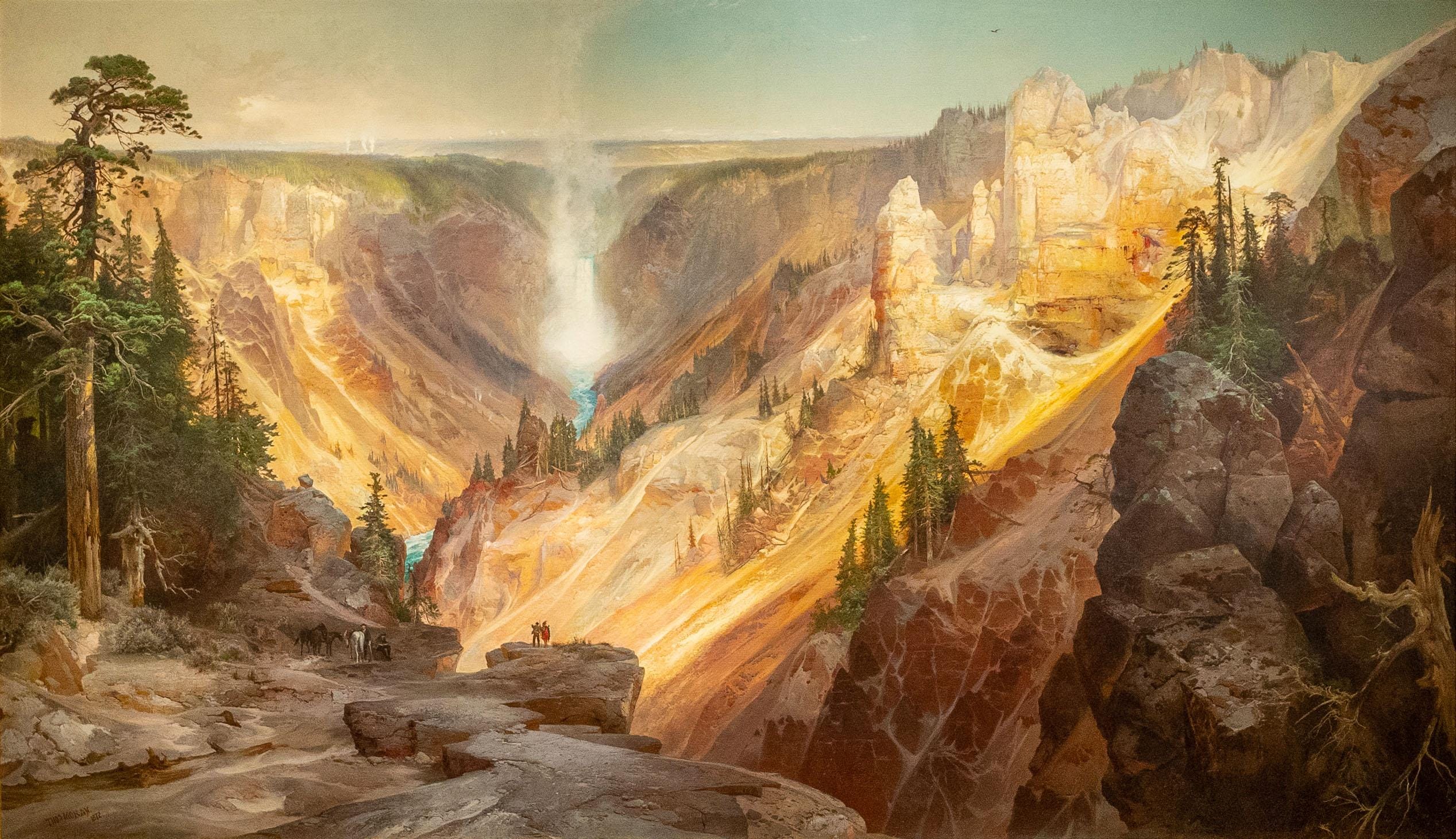
You see a compelling carousel of Grand Canyon images on the internet. However deeply you intuit its grandeur—or imagine yourself standing at the ledge—it does not give you the feeling. The images do not change you, not in the way you really want.
So you plan a trip. But when the tour bus pulls into that sun-baked parking lot, you find yourself in a fight with your partner. You see the limitless sky, the red horizon of layered rock, the great rift between—but you do not feel it. You are distracted. You are not present. And it does not change you, not in the way you really want.
Both experiences fall short for the same reason: something essential is missing. Attention alone is not enough. Embodiment alone is not enough. Only together do they open what might be called a third space—where imagination becomes perception.
Formulations of the lost middle
What we call this “third space” is not my idea, nor is it particularly new. It might feel that way, but that’s because we’ve lost the language for it.
For much of human history, transformation was never believed to occur purely inside the mind, nor merely through contact with the external world. It happened in a middle region—an in-between—where perception of reality and imagination are not so cleanly divided.
Shamanistic societies brought the environment and the animals around them into myth and story. The shaman took the real into an interpretative place with ritual. They made meaning and identity for the tribe within the liminal.
Those cultures did not separate the world neatly into boxes. In ritual, myth, and art, rather than an imposition, meaning was drawn out from reality. The shaman, the priest, the poet—all operated within a threshold space where the visible and invisible met.
In the Western tradition, the Greeks first began to articulate it. We can look to Plato and his concept of the metaxu—the “between”. The cave is more than simply a place of illusion, nor is the world outside just a collection of objects. The soul and its meaning only form in the movement between them. Escaping the cave isn’t simply to see more, but to see differently. When that shift occurs, the individual is changed.
Later traditions preserved this intuition, even if they named it differently. There is the threshold—the crossing—that always occurs in ritual, myth, or sacred art. The initiate enters one way and emerges another. We often use spatial language, but these spaces are not reducible to merely physical setting. They emerge in interaction with inner states of reflection.
As I often notice, however, the modern world has largely flattened this understanding.
We have reduced the outer world to matter—measurable, usable, and inert. On the other hand, we have reduced the inner world to psychology—private, subjective, and ultimately secondary. Whatever remains between them has become fantasy or illusion. As modern people, we can’t fathom how imagination was once a mode of knowing. It is treated now as a mode of escape.
French philosopher Henry Corbin drew a useful distinction in Mundus Imaginalis, between the imaginary and the imaginal. The imaginary is what we typically mean today—fiction, invention, or the not-real. But the imaginal refers to something else entirely: a real mode of perception, through which meaning is discovered rather than fabricated. It is a different kind of reality than the physical world, accessible through a certain kind of attention. It is real in the same sense that a concept like friendship is true, as true as the freezing point of water, even though it cannot be quantified or measured.
This is the space we enter when a poem suddenly opens, when a painting becomes more than pigment on canvas, when a landscape—the Grand Canyon—transcends scenery into revelation. We do not project meaning onto the world, nor does the world impose itself on us. Rather, something happens between.
That is the place where transformation becomes possible.
The Literary Tradition
If the third space has a history, then it is preserved best in literature. For while philosophy gives us the shape and structure of reality, literature trains us how to see and embody it.
Even in grade school, we learn a poem does not simply describe the world. It asks something of the reader. There’s a particular kind of attention required—slower, more patient, and at its best more participatory. It makes a poor medium for the kind of consumption we’ve grown accustomed to with our phones and social media.
When we read poetry, we enter it. In doing so, we enter that middle region.
Writing at the dawn of the Industrial Revolution, William Wordsworth understood this. He saw what was being lost—the kind of perception that made the world an encounter, not just material to be measured, used, or passed through.
Imagination is the means of deep insight and sympathy, the power to conceive and express images removed from normal objective reality.
—William Wordsworth
His poetry is concerned with how we see the world. It reawakens the faculty through which we do so. More than adding ideas or explicit philosophy, Wordsworth reshapes attention.
Rainer Rilke, writing a century later, sharpens this into something more demanding. In his Archaic Torso of Apollo, the encounter with beauty is not passive. The fragmented statue—headless, incomplete—resists being diminished. As the poem unfolds, the opposite happens.
We cannot know his legendary head
With eyes like ripening fruit. And yet his torso
Is still suffused with brilliance from inside,
Like a lamp, in which his gaze, now turned to low,
Gleams in all its power. Otherwise
The curved breast could not dazzle you so, nor could
A smile run through the placid hips and thighs
To that dark center where procreation flared.
Otherwise this stone would seem defaced
Beneath the translucent cascade of the shoulders
And would not glisten like a wild beast’s fur:
Would not, from all the borders of itself,
Burst like a star: for here there is no place
That does not see you. You must change your life.
The final utterance—you must change your life—is the challenge. The work of art becomes more than an object of appreciation. It demands something. The reader is no longer outside the experience. He is implicated in it.
T.S. Eliot, writing in the shadow of WWI and modern collapse, carries this further still—but in an even more exacting register. Where Rilke confronts the reader in a moment, Eliot seeks transformation over time.
Famously, his poetry does not yield itself at once. It resists immediacy and demands a return. Certain lines echo across poems, images recur in altered forms, seemingly distant fragments tease a kind of coherence—but never all at once. Meaning is found in accumulation.
Eliot offers perhaps the clearest example of this third way. Insight, if it comes at all, is earned through attention. The reader must dwell—he must remember, revisit, and hold together what doesn’t immediately cohere.
Eliot resists summary. His work must be experienced as a whole—through repetition and patient attention. I encourage you to do so here:
http://www.davidgorman.com/4quartets/2-coker.htm
When reading closely, something almost imperceptible shifts. This isn’t Rilke’s command—it is a reordering. Time itself begins to feel different as past and present collapse into one another. The familiar becomes strange. More than simply reading Eliot, one begins thinking within him—seeing through a structure not one’s own.
This is the third space extended. And it isn’t unique to these writers. It can be found in all great art if we only give it the time and attention it deserves.
Formation
What has been lost is not difficult to name. We feel it instinctively. The inability to dwell. The impatience with difficulty. The sense that nothing quite reaches us in the way it should. But the more important point is this: the loss is not total.
The third space has not disappeared. It has only become rare—easily missed, easily abandoned, but still available wherever attention and embodiment are brought into alignment.
What is lacking is precisely the rituals of initiation and transformation that once gave people a firm sense of place and identity. Entering the third space, where modern language struggles to make sense, is where that change is ignited.
We do not need more information. We need participation in forms not our own. If we but inhabit another’s perception, another’s rhythm, another’s way of seeing, we can begin to shift.
Older traditions understood this impulse as imitation, which can be formalized as apprenticeship. To read deeply was to internalize a structure of perception and take it on to reform one’s own way of seeing.
It’s not a question of whether or not we are shaped, but by what.
The third space makes this visible. It slows the process. It allows us to choose—however briefly—what we submit ourselves to. But like a muscle, we must use it regularly lest it atrophy.
Returning
The Grand Canyon does not need us.
It will remain what it is—vast, indifferent, unmoved by whether we notice it or not. But our encounter with it depends on something fragile. Proximity alone does not cut it. Intention alone falls short. There must be a convergence.
Attention. Presence. Participation.
When we give these away for free, the most profound realities pass by us unchanged. By claiming them, even the most mundane, familiar things can open. This is the promise of the third space.
But then, not every encounter will transform us. Meaning inevitably slips through our fingers. When we are ready, though, when a moment calls to us, there is still a way of meeting the world. Transformation remains possible.
And in those moments —however rarely—the demand remains:
You must change your life.
Thanks for reading, as always.
I'm a sucker for your grand canyon example. I don't know how many photos of it I'd seen before going there in person, none of them prepared me for what I experienced the first time the bend in the road brought me close enough that the trees thinned and something awesome became visible